Rotorua sits on the southern shore of its namesake lake, inside a massive caldera formed 240,000 years ago. That volcanic origin defines every project here. Loose pumice-rich soils, layers of Taupo ignimbrite and shallow steamfields create a ground profile unlike anywhere else in New Zealand. When a developer near Fenton Street proposed three-storey units on old lake terrace material, settlement estimates exceeded 80 mm under static load alone. Standard compaction could not reach the required depth. The site needed a vibrocompaction design that accounted for variable saturation zones and temperatures reaching 60 °C just 3 metres down. Stone columns can help where fines exceed 15 %, but clean sands respond directly to vibratory densification. We tie the design to NZS 3404 and the NZGS ground improvement guidelines, calibrating relative density targets to post-treatment CPT checks and the specific seismic demand of the Taupo Volcanic Zone.
In Rotorua, vibrocompaction design must handle two variables simultaneously: loose volcanic soil and geothermal heat that alters probe performance.
Technical details of the service in Rotorua
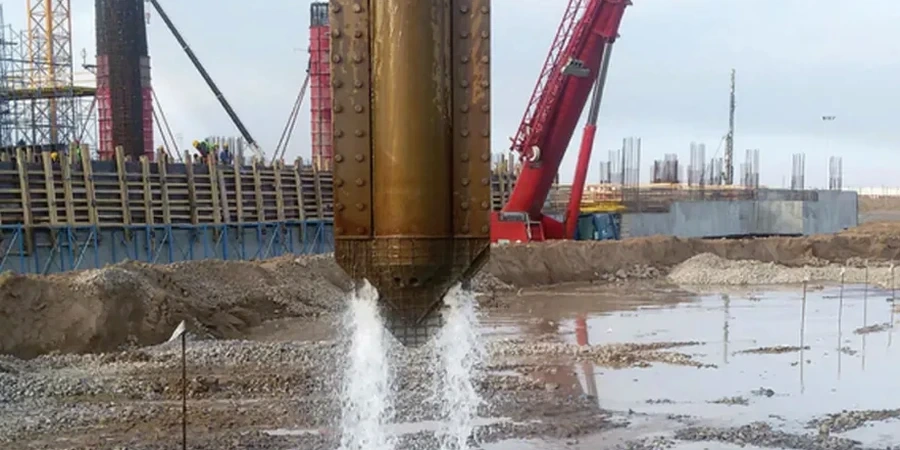
Critical ground factors in Rotorua
Lake Rotorua's water table sits less than 2 metres below ground across much of the CBD and the lakefront suburbs. Combine that with loose, unsaturated pumice sands that collapse on wetting, and you have a textbook settlement risk. We have seen sites where a broken stormwater pipe triggered 120 mm of differential settlement in three days. Vibrocompaction without proper saturation control can worsen this, trapping water pockets that later drain and leave voids. Thermal alteration is another local hazard. Silica-rich groundwater precipitates inside the probe tip when temperatures fluctuate, reducing vibration amplitude. Our designs include a thermal survey before grid layout. Where ground temperature exceeds 70 °C, we adjust probe advance rate and specify intermittent water flushing. The goal is a homogeneous density increase that survives both seismic shaking and the slow chemical changes Rotorua's geothermal fluids impose on the soil matrix over decades.
Our services
We deliver vibrocompaction design as a complete package, not just a grid drawing. The two core services cover the full project lifecycle.
Design package for resource consent
We prepare the full design report with CPT interpretation, liquefaction trigger analysis, grid layout, depth staging, backfill specification and temperature contingency plan. The package meets Rotorua Lakes Council engineering approval requirements and includes producer statements.
Construction-phase verification and adjustment
During treatment we run parallel CPT soundings and geophone settlement measurements. If the probe encounters unexpected steam pockets or silica-cemented crust, we modify the grid on site and issue an as-built design record.
Questions and answers
What does vibrocompaction design cost for a Rotorua site?
Design fees range from NZ$2,470 for a single-dwelling lot up to NZ$9,020 for a large commercial site requiring deep CPT grids and thermal analysis. The final figure depends on the number of CPTs, the treatment depth and whether a peer review is required by Council.
How do you verify the design worked on the hot ground near Whakarewarewa?
We run post-treatment CPT soundings inside and between probe points, plus a geophone settlement array for 14 days. In high-temperature zones we also monitor probe temperature logs and check backfill for silica scaling. Acceptance is tied to relative density and a maximum settlement threshold under design load.
Can vibrocompaction replace deep piles on pumice sand?
Yes, when the fines content stays below 12 % and the improved ground achieves 80 % relative density. For sites with higher fines or interbedded silt layers, we may combine vibrocompaction with stone columns or recommend a piled solution. We always run a feasibility CPT before committing to the approach. More info.