Roading projects in Rotorua face two very different subgrade realities depending on which side of the city they occupy. The western suburbs toward Ngongotahā sit on young rhyolitic tephras and pumice-rich layers from the Mamaku Plateau, materials that compact well but can lose significant strength when saturated. Head east toward Lake Rotoiti and the ground shifts to hydrothermally altered materials, where elevated temperatures and mineralogical changes create subgrades with unpredictable moisture sensitivity. A standard Proctor compaction test establishes the density-moisture relationship for these volcanic soils, but the laboratory CBR test is what determines whether the compacted subgrade can actually support the design traffic loading. Without site-specific CBR data from both ends of this geological spectrum, pavement designs risk either costly over-specification or premature deformation under the tourist and logging traffic that defines Rotorua’s road network.
A soaked CBR of 3% versus 8% can mean the difference between a 150 mm granular overlay and a full 300 mm pavement rebuild — and in Rotorua’s geothermal zones, that difference often hides in the clay mineralogy.
Technical details of the service in Rotorua
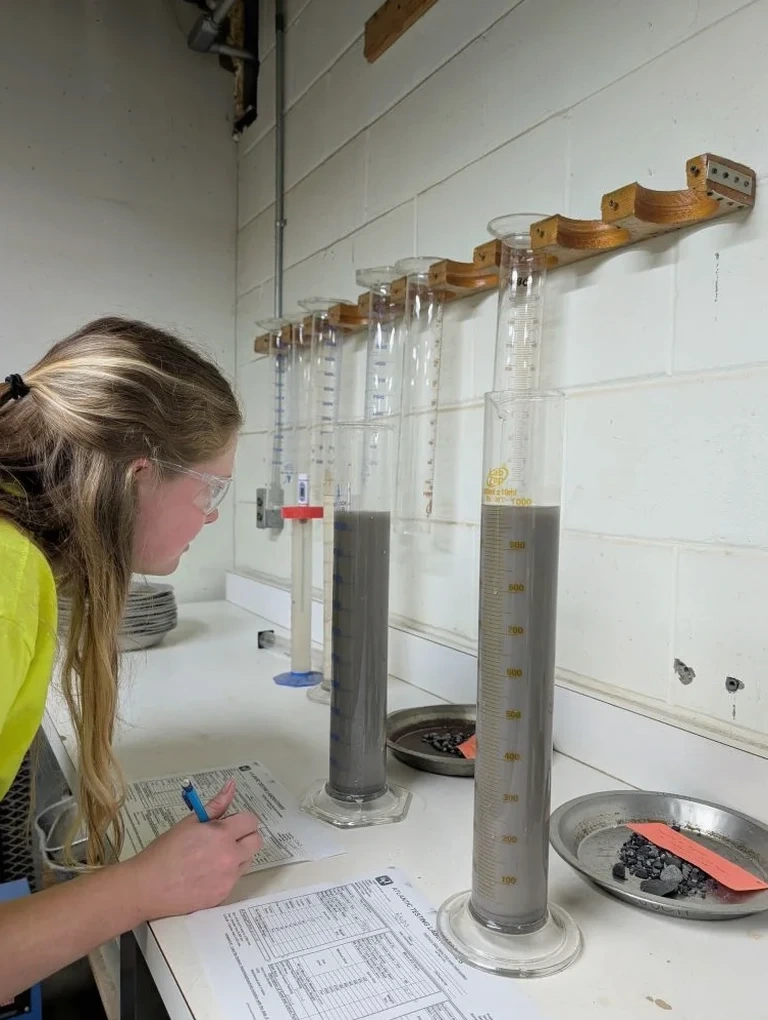
Critical ground factors in Rotorua
Rotorua’s urban expansion since the 1960s has pushed residential and arterial road construction into areas once considered marginal due to geothermal activity and soft lacustrine sediments. Early subdivisions around the lake margins often placed pavements directly on natural ground with minimal investigation, and decades later, many of these roads exhibit the characteristic longitudinal cracking and edge deformation of subgrade shear failure. The laboratory CBR test provides a direct measurement of the subgrade’s resistance to this type of failure, but only when the test conditions replicate the worst-case moisture scenario. A subgrade that tests at CBR 12 unsoaked but drops to CBR 4 after soaking is fundamentally a CBR 4 design soil, and ignoring the soaked value in Rotorua’s high-rainfall environment invites rapid deterioration. The NZTA’s pavement design supplement specifies minimum soaked CBR thresholds for each traffic volume category, and falling below CBR 3 typically triggers the need for subgrade modification or a stabilised foundation layer, costs that are far easier to absorb at the design stage than during a premature rehabilitation contract.
Our services
The laboratory CBR test is one component of a complete pavement investigation. For Rotorua roading projects, we pair it with field density and compaction control services that ensure the design CBR is achieved in the constructed subgrade.
In-Situ Density Testing for Pavement Construction
Post-compaction verification using nuclear densometer or sand cone methods to confirm that subgrade and granular layers meet the density and moisture targets established during the laboratory CBR testing programme.
Grain Size Distribution Analysis
Wet sieving and hydrometer analysis per NZS 4402 to classify Rotorua’s volcanic and geothermal soils, providing the gradation data needed to interpret CBR results and specify granular overlay thicknesses.
Questions and answers
How much does a laboratory CBR test cost in Rotorua?
Laboratory CBR testing typically ranges from NZ$180 to NZ$320 per specimen, depending on whether a single-point or three-point Proctor compaction curve is required first. A three-point Proctor plus one CBR specimen (soaked and unsoaked) is the most common package for roading projects. Bulk discounts apply when multiple samples from the same site are processed together, and urgent turnaround can be arranged for an additional fee.
How long does the CBR test take from sample delivery to results?
A standard laboratory CBR test requires seven to ten working days from sample receipt to final report. The four-day soaking period is mandatory and cannot be shortened without compromising the result’s validity for pavement design. Expedited testing is available where the Proctor compaction curve is completed in advance and the CBR specimen is set to soak immediately upon arrival.
Do I need both soaked and unsoaked CBR values for Rotorua pavements?
Yes, and NZTA’s design supplement explicitly requires the soaked CBR value for pavement thickness determination. The unsoaked value is useful for construction-stage quality control and for assessing the sensitivity of the material to moisture, which is particularly important in Rotorua where pumice and hydrothermally altered soils can show dramatic strength loss upon saturation. Reporting both values gives the pavement designer a complete picture of subgrade behaviour.
What sample size is needed for a laboratory CBR test?
Each CBR specimen requires approximately 6 kg of material passing the 19 mm sieve, and a three-point Proctor compaction curve requires an additional 15-20 kg. For a typical road investigation in Rotorua, we recommend collecting 25-30 kg of bulk sample per test location, sealed in heavy-duty plastic bags to preserve in-situ moisture. Samples should be transported to the laboratory within 48 hours of extraction to prevent moisture loss. More info.