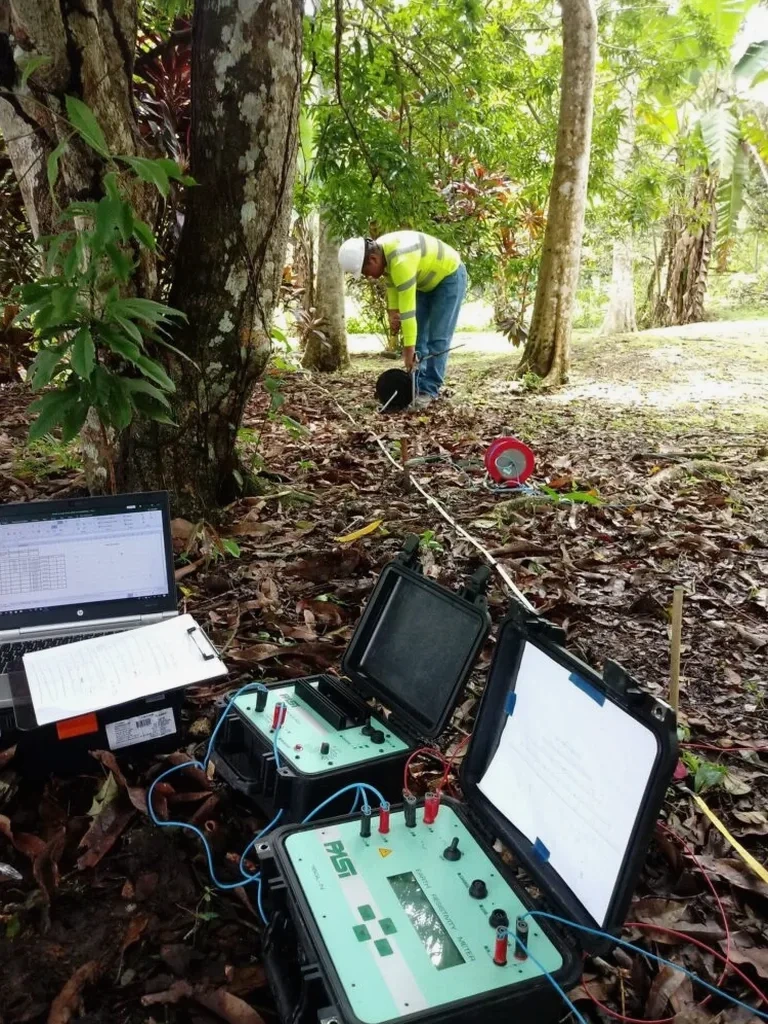
The geothermal setting of Rotorua, with its extensive subsurface hydrothermal activity and complex volcanic stratigraphy, demands geophysical methods that can distinguish fluid-saturated zones from competent rock. Electrical resistivity surveys, particularly Vertical Electrical Sounding (VES), respond sharply to the contrast between highly conductive geothermal fluids, clay-rich alteration haloes, and resistive rhyolite domes that underlie much of the city. A conventional drilling program near the Rotorua caldera margin often encounters unpredictable ground conditions; integrating resistivity data beforehand reduces the risk of intercepting pressurized thermal water or collapsing into soft, hydrothermally altered tuff. Our field teams deploy Schlumberger and dipole-dipole arrays with acquisition parameters aligned to the local geology, where the water table — often perched within the Taupo Volcanic Zone ignimbrite — strongly influences the measured apparent resistivity curve.
Resistivity imaging in the Taupo Volcanic Zone resolves fluid pathways and clay caps that standard drilling alone would miss completely.
Technical details of the service in Rotorua
For projects where the target depth exceeds 30 metres or where lateral changes in ground conditions are suspected, we combine the VES survey with a seismic refraction line to cross-validate the interpreted bedrock interface. The utility of resistivity methods here is not just in mapping depth-to-rock but in delineating the boundaries of thermal groundwater plumes, a critical factor when designing dewatering systems or assessing aggressive soil conditions for buried concrete. Data inversion follows solid least-squares fitting routines, with the output tied to local borehole logs wherever available to constrain the model layers.
Critical ground factors in Rotorua
The geotechnical contrast between the lakeside pumice flats around Ngapuna and the densely welded ignimbrite plateaus of the western suburbs is stark. Near the lake, post-eruption lacustrine sediments and diatomaceous silts produce low-resistivity signatures that can be mistaken for a shallow water table, while the western ridges show high-resistivity profiles that mask deep weathering zones within the Mamaku Ignimbrite. Misinterpreting a low-resistivity layer as groundwater when it is actually conductive clay alteration, common around former hot spring vents, leads to flawed foundation assumptions. A calibrated electrical resistivity survey in Rotorua eliminates that ambiguity by providing a continuous profile of the subsurface, allowing the engineering team to position boreholes and test pits precisely where the geophysical contrast indicates a transition in material properties rather than guessing from sparse point data alone.
Our services
Our electrical resistivity services in the Rotorua region are structured to address the specific challenges of volcanic and geothermal terrain. Each survey design is preceded by a review of existing geological maps and thermal area boundaries.
1D Vertical Electrical Sounding (VES)
Point-specific depth investigation using expanding Schlumberger array. Ideal for determining depth to bedrock beneath pumice cover or identifying the freshwater-saline interface near the lake margin.
2D Electrical Resistivity Tomography (ERT)
Multi-electrode profiling along linear transects to map lateral changes in subsurface materials. Applied extensively for pipeline routing through mixed alluvial and ignimbrite sequences.
Combined Resistivity and Induced Polarization (IP)
Dual-mode surveys that measure both resistivity and chargeability. Useful for discriminating between clay-rich hydrothermal alteration zones and true groundwater-saturated layers in the Rotorua caldera.
Questions and answers
How much does an electrical resistivity survey cost in Rotorua?
For a typical VES sounding or a short 2D resistivity line in the Rotorua area, budgets generally fall between NZ$1,060 and NZ$1,600. The final figure depends on the array length, target depth, and the complexity of electrode grounding in the local pumice soils.
Can electrical resistivity distinguish steam zones from water-saturated ground?
The reference range for this service in Rotorua is NZ$1.060 - NZ$1.600. The final price depends on the project scope and volume.
What specifications apply to resistivity testing for geotechnical investigations?
Field procedures follow ASTM D6431-18 for direct current resistivity, with inversion parameters documented according to NZGS geotechnical investigation guidelines. Survey grids are tied to site datum using RTK GPS for accurate spatial reference. More info.