A retaining wall in Fenton Park and one in Ngongotaha face completely different ground conditions, even though both sit within the Rotorua caldera. In Fenton Park you often hit stiff, sintered silts within a few metres, while down by the lake at Ngongotaha the profile turns soft and wet, with groundwater barely a metre down. That difference dictates everything: footing width, drainage provision, and whether a simple cantilever will work or whether you need to step up to a counterfort or an anchored wall. We combine shear strength testing with local geological knowledge to size the stem, heel, and toe for the actual ground on your site, not a generic textbook profile.
A wall that fails in Rotorua usually fails because of water, not because the concrete was too thin. We design the drainage first, then the structure.
Technical details of the service in Rotorua
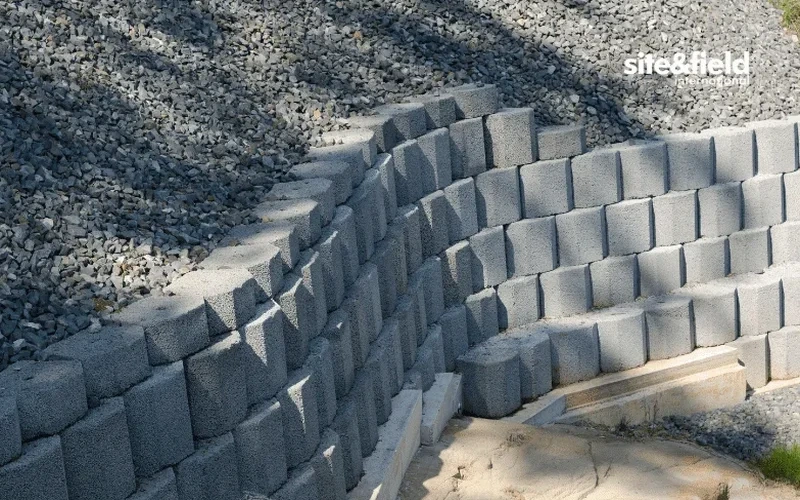
Critical ground factors in Rotorua
Rotorua sits 280 metres above sea level on the southern shore of Lake Rotorua, with a permanent population above 58 000 that swells with tourism. The city has been shaken by events like the 1987 Edgecumbe earthquake, and the ground here can amplify motion in ways that turn a standard retaining structure into a hazard. Liquefaction of loose pumiceous layers is a recognised risk in the lake fringe suburbs, and a wall that loses its passive wedge during shaking will rotate or slide before anyone can react. We model both static and seismic load cases, factoring in short-term and long-term pore pressure regimes, and we never assume drained conditions for fine-grained backfill unless the numbers prove it. Global slip circles are checked with limit equilibrium software, and we include bench cuts or temporary shoring when the excavation is deeper than 1.5 metres.
Our services
Every retaining wall design we issue for Rotorua sites includes a full calculation package and a set of drawings a contractor can actually build from. These are the two core deliverables.
Gravity and cantilever wall design
Reinforced concrete and mass concrete walls designed for heights from 0.8 m to 6.0 m. Includes bearing capacity, overturning, sliding, and global stability checks, plus drainage detailing.
Anchored and soldier pile walls
Steel soldier pile systems with timber lagging or shotcrete facing, designed for tight sites where excavation space is limited. Tie-back anchors sized for the pumice and ignimbrite layers common in Rotorua.
Questions and answers
Do I always need a building consent for a retaining wall in Rotorua?
Under the Building Act, a retaining wall higher than 1.5 metres, or a wall retaining a surcharge such as a driveway or building, requires a building consent. Walls below 1.5 metres that are not near a boundary or loaded area may be exempt, but we always check the specific site conditions against the Rotorua Lakes Council rules before assuming an exemption.
What does retaining wall design cost for a residential project in Rotorua?
Residential retaining wall design fees in Rotorua generally range from NZ$1,790 to NZ$6,840, depending on wall height, complexity, and whether anchored systems or drainage design beyond standard detailing are required. A simple gravity wall up to 2 metres falls at the lower end, while a soldier pile wall with tie-backs and seismic analysis sits at the upper end.
How do you handle the acidic groundwater in Rotorua for retaining wall design?
In zones where groundwater pH drops below 6.0, we specify sulphate-resisting cement or protective coatings for steel elements and adjust the minimum cover to reinforcement. The geothermal influence in Rotorua means we test water chemistry early in the design phase so the durability requirements are built into the specification from the start.
Can you design a retaining wall on a boundary in Rotorua without encroaching on the neighbour?
Yes, but it requires careful detailing. We often use a cantilever wall with the stem set back from the boundary, or a soldier pile wall placed entirely within the client's property. Temporary excavation support may be needed during construction, and we coordinate with the neighbour if the works require access to their side under the provisions of the Property Law Act.