We see it often. A contractor breaks ground in Rotorua, finds stiff-looking material at 600 mm, and assumes a standard 150 kPa bearing capacity is safe. Within two wet seasons, differential settlement cracks the slab. The problem wasn't the load. It was the soil's response to moisture—typical of the Taupo Pumice Alluvium that blankets much of the city. A proper soil mechanics study here means distinguishing between a desiccated crust and the compressible pumiceous silts beneath it. We combine field logging with laboratory index testing to define a profile that holds up under Rotorua's real drainage conditions. For example, when pumice layers are suspected, a complementary grain size analysis reveals whether fines content creates a collapse potential that field observation alone would miss.
Assuming uniform ground in the Taupo Volcanic Zone is the single most expensive shortcut a Rotorua project can take.
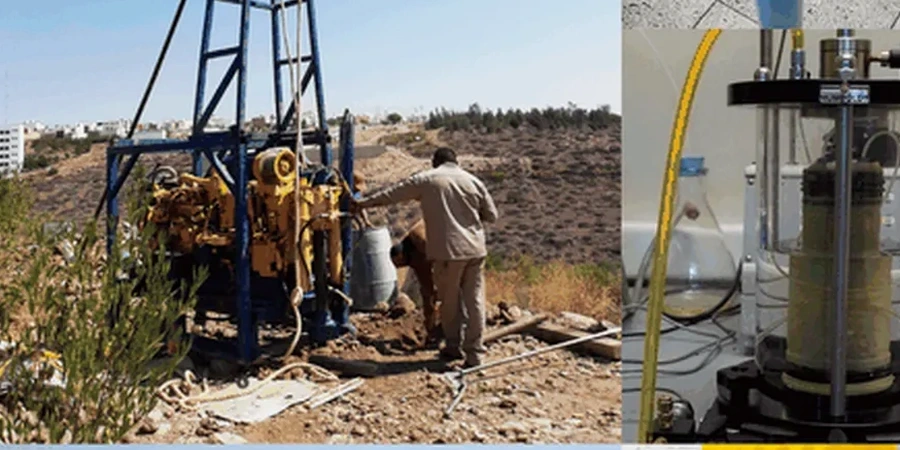
Technical details of the service in Rotorua
Critical ground factors in Rotorua
NZS 3404 references NZGS Module 2 for site investigation, and in Rotorua that requirement is not a formality. The Rotorua urban area is mapped as having moderate to high geothermal hazard, and the district plan requires geotechnical assessment in areas with mapped hydrothermal alteration. Ignoring this means exposing foundations to acidic groundwater that attacks ordinary Portland cement within a decade. We have pulled cores in Whakarewarewa where the soil pH measured 4.1 and the sulphate content exceeded 800 mg/kg, triggering Class 3 exposure under NZS 3101. A soil mechanics study that omits chemical analysis in Rotorua is incomplete by definition. The same investigation must address liquefaction susceptibility in the pumiceous silts along the Puarenga Stream corridor. The low-density grains crush under cyclic load, and the behaviour differs from the hard-sand liquefaction models imported from Christchurch. We use the NZGS liquefaction triggering framework with site-specific fines content from our laboratory to build a defensible assessment.
Our services
The Rotorua soil mechanics study scope is assembled for each site, but two investigation packages cover the majority of residential and light commercial projects in the district.
Foundation soil assessment
Borehole drilling with SPT sampling across the footprint, laboratory classification (PSD, Atterberg, moisture content), chemical suite for pH and sulphate, bearing capacity and settlement analysis per NZS 3404, and recommendation on ground improvement if collapsible pumice layers are identified.
Slope and retaining wall investigation
Targeted drillholes or test pits on cut faces, undisturbed sampling for direct shear or triaxial testing, back-analysis of existing slopes where instability is observed, and earth pressure parameters for retaining wall design under drained and undrained conditions.
Questions and answers
What makes Rotorua soils different from other North Island sites?
The Taupo Pumice Alluvium and hydrothermally altered silts dominate. These soils have low dry density, high void ratios, and can collapse when wetted under load. In geothermal areas, low pH and elevated sulphates attack concrete. A soil mechanics study here must address both mechanical and chemical behaviour, not just bearing capacity.
Do you need a soil mechanics study for a single-storey residential build in Rotorua?
Yes. The Rotorua District Plan triggers geotechnical review in areas of known geothermal hazard, and even outside those zones, the pumiceous soils are prone to collapse upon wetting. Building consent authorities routinely request a site-specific investigation report before issuing foundation consent.
How deep are the boreholes typically drilled in Rotorua?
For a standard residential slab, we drill to 8–10 metres or until we reach competent ignimbrite. Where deep pumice deposits are present, we may extend to 15 metres to capture the full compressible layer and check for a firm bearing stratum at depth.
How much does a soil mechanics study cost in Rotorua?
A residential investigation with two boreholes, laboratory testing, and a geotechnical report typically ranges from NZ$6,000 to NZ$9,390 depending on access, depth, and the laboratory suite required. Commercial or multi-storey projects with more boreholes and advanced testing are quoted per scope.
Can you reuse an existing geotechnical report from a neighbouring property?
Rotorua's subsurface is too variable over short distances to rely on a neighbour's data. Council will generally require a site-specific soil mechanics study unless the existing report demonstrably covers your lot with investigation points within the building footprint.