We ran a compaction verification job on a retirement village extension off Te Ngae Road last winter where the contractor was battling pumiceous silts that just wouldn't hold moisture. Three days of rain had turned the building platform into a sponge, and the council inspector wanted density figures before the floor slab went in. That's the reality of earthworks in Rotorua. The sand cone test gives us a direct, physical measurement of in-place density that a nuclear gauge simply can't match when you're dealing with variable volcanic ash layers and scattered hydrothermal alteration. Our crew has performed field density testing across dozens of subdivisions from Ngongotaha to Waipa, and the method remains the referee in any dispute about compaction quality. The procedure follows ASTM D1556 and ties directly into NZS 4404:2010 earthworks acceptance criteria, which is what council engineers expect to see on the sign-off sheet. For deep fill projects where the underlying material is suspect, we often recommend pairing the sand cone with a test pit investigation to verify layer thickness and identify any hidden soft spots before the density program begins.
A sand cone test gives you a physical density number you can verify with a shovel and a scale — there is no radiation source to license and no calibration drift to argue about.
Technical details of the service in Rotorua
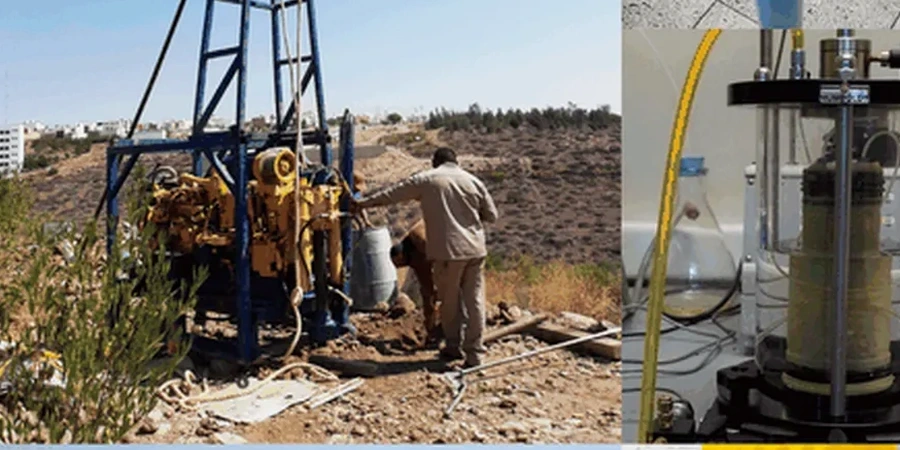
Critical ground factors in Rotorua
The equipment itself is deceptively simple: a sand cone jar, a base plate with a circular opening, and a can of calibrated Ottawa sand. You excavate a test hole through the compacted lift, carefully recover every gram of soil, then pour dry sand from the jar to measure the hole volume. In Rotorua's geothermal areas, the ground can be warm to the touch, and steam drifting across the test plate will condense on the sand and throw off the mass calibration. We have learned to shield the apparatus and work quickly. The biggest risk on site is not the test procedure but the sampling pattern. A single sand cone test represents about 0.03 m² of a 500 m² building platform, so the spacing matters enormously. NZS 4431 guidelines for residential earthworks call for one test per 100 m² per lift, but on variable pumice fills we tighten that to one per 50 m² in critical zones. Missing a loose pocket under a future shear wall is an expensive mistake that a well-designed testing grid prevents.
Our services
Our Rotorua field density service covers the full cycle from laboratory reference testing through to on-site verification and council documentation.
Earthworks Compaction Verification
Field density testing on subdivision fills, building platforms, and utility trench backfill using the sand cone method. We provide the laboratory Proctor reference curve, conduct on-site tests at the required frequency per NZS 4431, and issue a signed density report within 24 hours for council sign-off.
Pavement Subgrade and Aggregate Base Control
Density control for road subgrade and granular basecourse layers in accordance with NZTA B/2 specification. Testing covers both the subgrade CBR correlation layer and the compacted aggregate base, with results reported as percentage of maximum dry density.
Questions and answers
What does a sand cone field density test cost in Rotorua?
A single sand cone density test in the Rotorua area typically runs between NZ$160 and NZ$210, depending on site access and the number of tests scheduled on the same day. That price includes the laboratory Proctor reference test on your fill material, the field density measurement, and the signed report. For larger subdivision projects with 20 or more tests, we can offer a reduced per-test rate.
How long does it take to get the density test results on site?
The field procedure takes about 20 minutes per test location. The technician can give you a verbal result on the spot once the mass and volume calculations are complete. The formal signed report is typically emailed within 24 hours, which keeps the earthworks program moving without delays waiting for documentation.
Why use the sand cone method instead of a nuclear density gauge in Rotorua?
The sand cone method avoids the regulatory requirements of owning and transporting a nuclear source, and it is not affected by the chemical composition of the soil. In Rotorua's geothermal areas, altered soils can contain minerals that interfere with a nuclear gauge's calibration, whereas the sand cone gives a direct physical volume and mass measurement that is independent of soil chemistry.
What compaction standard do Rotorua council inspectors require for residential fills?
Rotorua Lakes Council typically requires compacted fill to achieve 95% of the standard Proctor maximum dry density (NZS 4402 Test 4.1) or 90% of the modified Proctor (Test 4.2) for building platforms, with a minimum of one field density test per 100 m² per compacted lift. We coordinate directly with the council's engineering team to ensure the testing program meets their current acceptance criteria.