Rotorua's ground profile rarely reads like a textbook. The combination of rhyolitic ash layers, hydrothermal alteration, and fluctuating water tables across the caldera floor creates a subsurface where strength parameters can shift dramatically within a single borehole. We see this constantly in projects near the lakefront and throughout the Fenton Street corridor—what starts as a stiff silty gravel at 3 metres can transition into a soft, sensitive clay at depth, often with temperatures still elevated from the geothermal system below. For any structure imposing significant load, or any excavation that needs to stand open, a standard penetration test simply won't capture the full story. That's where a properly executed triaxial test programme becomes essential, providing the drained and undrained shear strength data that feeds directly into bearing capacity calculations and finite element models. When we combine these results with field data from CPT testing, the stratigraphic picture sharpens considerably.
Effective stress parameters from a CU triaxial test are not interchangeable with drained parameters from a CD test—mixing them up is one of the most expensive mistakes we see in Rotorua foundation design.
Technical details of the service in Rotorua
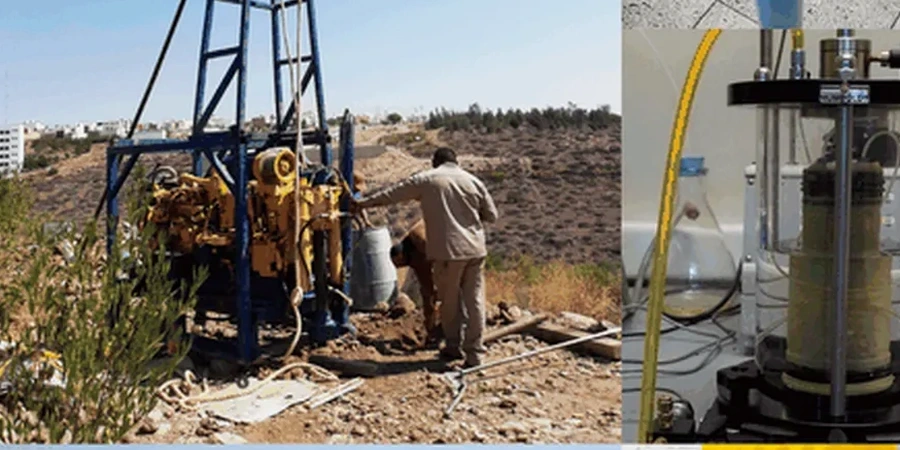
Critical ground factors in Rotorua
The mistake we encounter most often is a structural engineer accepting a single UU test result as representative of all soil layers across a Rotorua site. The geothermal environment creates localised mineral alteration—kaolinite and smectite zones within otherwise competent rhyolite—where undrained strength can drop by 60% over a distance of less than two metres. We reviewed a retaining wall failure on Old Taupo Road where exactly this happened: the designer applied a bulk Su of 80 kPa from one sample, missing a thin montmorillonite-rich seam that softened to 25 kPa when wetted during a heavy rain event. Proper triaxial testing across multiple depths, combined with a geological log that flags alteration colours and plasticity, would have caught the weak horizon. In Rotorua, skipping detailed strength profiling means gambling with a subsurface that has been chemically active for tens of thousands of years.
Our services
Our Rotorua laboratory runs three distinct triaxial configurations depending on the ground conditions and the design phase. We tailor the testing programme to the specific ash formations and loading scenarios encountered across the Bay of Plenty.
Consolidated Undrained (CU) Triaxial with Pore Pressure Measurement
The workhorse test for Rotorua's fine-grained soils. We saturate specimens under back pressure, consolidate to in-situ stress conditions, then shear undrained while monitoring excess pore pressure. This yields effective stress parameters (c' and φ') critical for long-term slope stability analysis in the caldera rim suburbs like Ngongotaha and Kawaha Point.
Unconsolidated Undrained (UU) Triaxial
Applied during construction-stage analysis for short-term bearing capacity on saturated cohesive soils. We run these on Shelby tube samples from the Rotorua lakebed deposits where drainage during rapid loading is negligible. Results feed directly into undrained shear strength (Su) profiles for foundation design.
Consolidated Drained (CD) Triaxial
Slow-shear testing for free-draining volcanic sands and gravels common in the Mamaku plateau margins. The test determines the true drained friction angle without pore pressure complications. We use this data for retaining wall design behind the many commercial developments along Amohau Street.
Multi-Stage Triaxial Testing
A practical option when sample recovery is limited. One specimen undergoes multiple confining stress stages, generating a full Mohr-Coulomb envelope from a single core. We recommend this for deep investigations in the geothermal field where continuous sampling is challenging and material is precious.
Questions and answers
What is the typical turnaround time for a triaxial test programme in Rotorua?
For a standard set of three CU triaxial tests on cohesive soil, we deliver results within 8 to 12 working days from sample receipt. Consolidated drained tests run longer due to the slow shear phase—allow 14 to 18 working days. If your project is on a tight timeline, we can stage the reporting: undrained parameters first for initial foundation sizing, drained results to follow for final design verification.
How much does triaxial testing cost for a Rotorua project?
Triaxial testing in Rotorua typically ranges from NZ$2,860 to NZ$3,940 for a three-specimen set (CU or UU), depending on specimen diameter and whether multi-stage loading is required. The final cost reflects the preparation time needed for Rotorua's often-sensitive volcanic soils, which demand careful trimming and extended saturation phases to achieve reliable B-values.
Which triaxial test type should I specify for the Taupo Pumice Alluvium common around Rotorua?
The Taupo Pumice Alluvium presents a challenge because it can behave as either drained or partially drained depending on its fines content and density. For loose, clean pumice sands above the water table, we recommend CD triaxial testing to capture the true drained friction angle. For the silty pumice layers found deeper in the caldera basin, CU with pore pressure measurement gives you both short-term undrained strength and effective stress parameters for long-term analysis.
Can you run triaxial tests on samples that have been affected by geothermal heat?
Yes, and this is a common situation in Rotorua. Samples from depths where ground temperatures exceed 40°C require special handling to prevent moisture loss and thermal shock during transport. We use insulated core boxes and process the specimens within 24 hours of drilling. The triaxial cell can be temperature-controlled to replicate in-situ conditions if needed, which is particularly important for projects near the Whakarewarewa geothermal field where soil behaviour at elevated temperature differs measurably from ambient conditions.