What we see repeatedly in Rotorua is that the ground never behaves like a textbook. The Taupo Volcanic Zone has laid down a complex sequence of soft pumice silts, hydrothermal clays, and unconsolidated tephra layers that can change stiffness over just a few metres. When you are planning a tunnel through this material, standard assumptions about stand-up time or face stability simply do not apply. Our lab has tested hundreds of samples from boreholes across the city—from the lakefront sediments near Sulphur Point to the rhyolite-derived soils out near the Whakarewarewa Forest. Interpreting those results correctly requires more than a generic report; it takes familiarity with how Rotorua’s geothermal environment alters soil fabric and pore water chemistry over time. For deeper ground characterisation we often pair our analysis with CPT testing to map continuous profiles before sampling.
Rotorua’s hydrothermal clays don’t just fail—they swell, creep, and lose strength when disturbed. A tunnel design here lives and dies by the quality of its pre-construction lab programme.
Technical details of the service in Rotorua
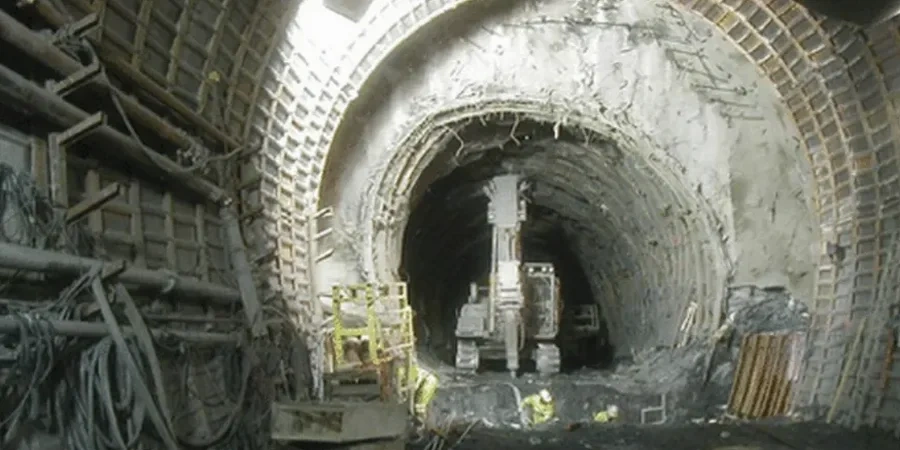
Critical ground factors in Rotorua
There is a stark difference in risk profile between driving a tunnel under the Fenton Street commercial corridor and attempting the same through the reclaimed fill and lacustrine deposits near the lakefront. The Fenton Street alignment often encounters the Rotorua Ignimbrite at depth, which provides a competent, if fractured, cap above softer zones. However, near the lake, the sediments are saturated, gas-charged, and extremely sensitive to vibration. In these areas, the biggest risk is not simply face collapse—it is the progressive loss of strength due to remoulding during excavation, which can trigger settlement troughs extending well beyond the tunnel alignment. Our laboratory testing specifically targets the sensitivity ratio and post-peak behaviour of these soils so that the design team can anticipate the true deformation pattern, not just the factor of safety.
Our services
A proper soft-ground tunnel investigation in Rotorua needs more than just index testing. The lab programme must replicate the stress path a soil element will experience as the face approaches and passes. Here is what our facility provides specifically for tunnel designers working in the Taupo Volcanic Zone.
Advanced Triaxial and Stress Path Testing
We run CIU, CAU, and CID triaxial tests with pore pressure measurement, as well as custom stress-path tests that simulate unloading during tunnel excavation. All tests include back-pressure saturation to manage Rotorua’s gas-rich samples.
Consolidation, Swell, and Creep Characterisation
Incremental oedometer tests with swell pressure measurement and long-duration creep stages. We quantify the secondary compression index (Cα) over realistic timeframes because montmorillonite-rich Rotorua clays exhibit significant time-dependent deformation.
Questions and answers
What makes Rotorua soils so challenging for tunnel construction?
The challenge comes from the combination of soft, normally consolidated pumice silts and the widespread hydrothermal alteration that produces sticky, swelling clays. Add to that dissolved volcanic gases trapped in the pore space and a groundwater table that is often artesian near the lake, and you have conditions that demand a very careful geotechnical laboratory programme. Standard classification tests miss the sensitivity and gas effects that control face stability here.
How much does a soft-ground tunnel geotechnical lab programme cost in Rotorua?
A comprehensive lab testing programme for a soft-ground tunnel in Rotorua typically ranges from NZ$7,860 to NZ$25,190, depending on the number of boreholes, sample quality, and the mix of triaxial, oedometer, and index tests required. A smaller investigation for a short section of trenchless installation sits at the lower end, while a full TBM design programme with stress-path testing and multiple sampling horizons is at the upper end.
Which tests do you recommend for a tunnel through Rotorua’s hydrothermal clays?
At minimum, we recommend a suite of consolidated-undrained triaxial tests with pore pressure measurement, incremental oedometer tests with swell pressure determination, and Atterberg limits on every distinct unit. If gas is encountered—and it often is—we also run gas content and composition analysis. For deeper tunnels, we add stress-path triaxial tests that replicate the unloading a soil element undergoes as the face advances, which gives the design team a more realistic stiffness for deformation modelling.