The ground beneath Kuirau Park and the ground near Lake Rotorua’s shoreline tell two completely different stories. One boils with geothermal activity, the other squirms on soft lacustrine sediments. A strip footing that works on the firmer ignimbrite ridges south of town will fail on the lakebed clays. Our team tackles this contrast daily. We apply raft foundation design precisely where differential settlement becomes the biggest threat to a structure. The whole slab works as one rigid plate, bridging pockets of weak soil that would destroy isolated footings. For sites with liquefaction triggers, we integrate densification recommendations before the raft goes in, and when geothermal steam zones complicate bearing, we lean on in-situ permeability data to adjust the sub-base drainage.
A raft foundation doesn't eliminate settlement—it makes settlement uniform, which is what keeps the cladding from cracking.
Technical details of the service in Rotorua
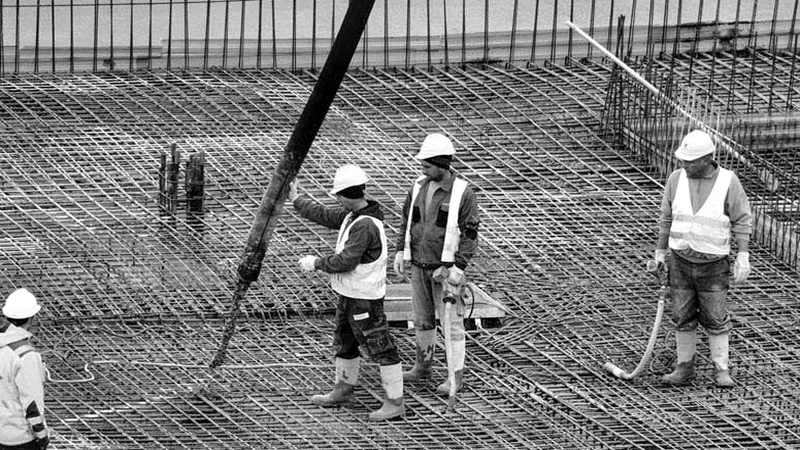
Critical ground factors in Rotorua
Rotorua sits at 280 metres above sea level, inside the Taupo Volcanic Zone, where the last significant crustal rupture was the 1987 Edgecumbe quake—magnitude 6.5. The city dodged the epicentre, but it exposed how quickly Rotorua’s pumice-rich soils lose strength under cyclic loading. A raft foundation design here must pass two checks: static bearing on the weak crust and seismic punching through the crust into the slurry below. We run finite element models with site-specific response spectra from NZS 1170.5. The failure mode that worries our engineers most is edge heave—where the slab corners lift during shaking and crack the superstructure. Our reinforcement detailing puts extra steel at the edges and around service penetrations to hold the raft together when the ground tries to tear it apart.
Our services
We deliver the full geotechnical-to-structural chain for raft foundations, starting with site investigation and ending with reinforcement shop drawings.
Geotechnical investigation for raft design
We execute CPT, SPT, and thermal probe surveys to build a 3D ground model. The output is a geotechnical interpretive report with bearing capacity, settlement curves, and subgrade modulus values calibrated for your Rotorua site.
Structural design & thermal isolation
We produce detailed raft reinforcement drawings, edge beam details, and thermal isolation details. Our designs account for H2S attack, steam venting, and the specific seismic demands of the Taupo Volcanic Zone.
Questions and answers
What does a raft foundation design cost in Rotorua?
For a standard residential raft on a Rotorua site, design fees typically range from NZ$1,790 to NZ$7,470 depending on slab area, ground complexity, and whether thermal isolation or liquefaction mitigation measures are required. A site with active steam vents or deep soft layers will push the engineering toward the upper end.
Why choose a raft over deep piles in Rotorua?
Rafts distribute load over the full footprint, which suits Rotorua's thin crust-over-slurry soil profile. Piles would punch through the crust and lose skin friction in the fluid-like material. A raft keeps the load in the competent upper layer. It also doubles as a ground slab, saving the cost of a separate floor system.
How do you handle geothermal heat under a raft?
We map ground temperature with shallow probes. Hot spots above 40°C get a ventilated cavity formed by biodegradable void formers, an HDPE vapor barrier, and sulfate-resistant concrete. The cavity lets heat escape laterally, preventing slab curling and chemical degradation of the concrete matrix.
What site investigation is needed before designing a raft?
Minimum three CPT soundings to 5 metres depth, plus one thermal probe per 100 m² of footprint. We also run Atterberg limits and unconfined compression on the crust material. If the site is within 500 m of Lake Rotorua, we add cyclic triaxial tests to assess liquefaction susceptibility for the seismic design case.