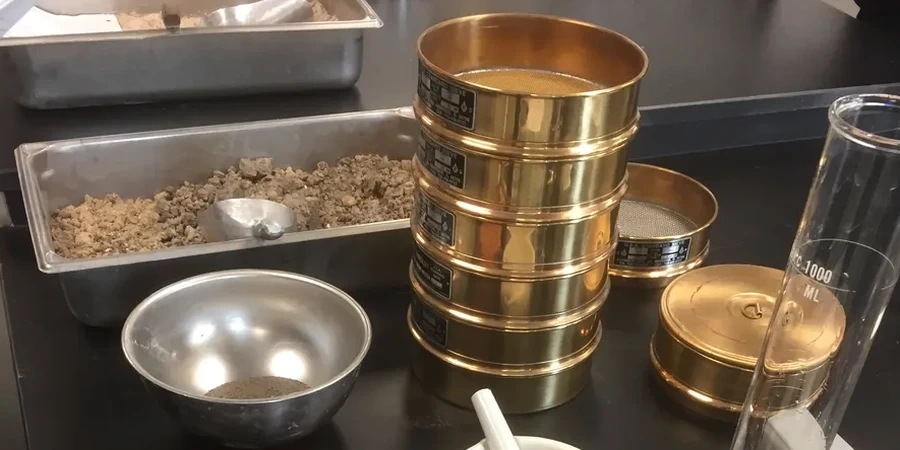
Rotorua’s geothermal setting creates soil profiles that standard tests often misread. Volcanic ash layers, hydrothermal clays, and pumice sands all coexist within a single borehole. A simple visual classification won’t tell you how much silt is actually suspended in that clay fraction, and in Rotorua that matters. The grain size analysis (sieve + hydrometer) maps the full particle distribution curve—from gravel down to colloidal fines smaller than 2 microns. We run the mechanical sieving first, then hydrometer sedimentation on the minus 75-micron fraction. This dual approach catches the gap-graded nature of many Taupo Volcanic Zone deposits. When the hydrometer data reveals unexpected silt percentages, we cross-check with Atterberg limits to verify plasticity behaviour, because some Rotorua silts behave like clays under load. The sieve stack captures the pumice-gravel fraction, and the hydrometer picks up the altered ash matrix that dominates the thermal areas near Whakarewarewa and south of Lake Rotorua.
A missing hydrometer run in Rotorua can hide 25 percent colloidal fines—enough to change the soil classification from sandy silt to sensitive clay.
Technical details of the service in Rotorua
Procedure video
Critical ground factors in Rotorua
Rotorua’s thermal alteration changes the mineralogy of the fines fraction—halloysite and allophane clays form from rhyolitic glass, and these minerals hold water differently. A standard sieve-only test misses this entirely. The hydrometer suspension can show a false-positive clay content if the dispersant fails to break down allophane aggregates, so we adjust the chemical dose based on the soil’s pH. Ignoring this step leads to a gradation curve that looks coarser than reality. The engineer then specifies a conservative bearing capacity that the ground doesn't actually have, or worse, overestimates drainage and leaves a foundation sitting in perched water. In the Sulphur Point area, acid-sulphate alteration produces extremely fine jarosite-rich silts with grain sizes below 10 microns. The hydrometer is the only tool that quantifies this fraction correctly. A liquefaction assessment in Rotorua without an accurate fines content curve from a hydrometer is guesswork—the NZGS-MBIE Module 4 procedure requires measured fines content, not an estimated value.
Our services
The grain size analysis runs as a standalone package or as part of a wider geotechnical investigation. Each service includes the full particle size distribution plot, Cu and Cc coefficients, and soil classification per the NZGS system.
Sieve analysis (coarse fraction)
Mechanical sieving of the oven-dried sample from 63 mm down to 75 microns. We weigh each retained fraction and plot the cumulative passing curve. Suitable for gravels, sands, and the coarse portion of silty soils.
Hydrometer analysis (fine fraction)
Sedimentation test on the minus 75-micron material. Hydrometer readings over 24 hours yield particle sizes from 75 microns down to roughly 1 micron. Temperature-corrected and dispersant-optimised for volcanic soils.
Questions and answers
Why does Rotorua require hydrometer testing instead of just sieve analysis?
Rotorua sits in the Taupo Volcanic Zone, and the soils contain high percentages of volcanic ash, hydrothermal clays, and altered silts. Sieve-only tests cannot measure the fine fraction below 75 microns, which often exceeds 30 percent here. The hydrometer quantifies the silt and clay sizes that control drainage, plasticity, and settlement behaviour.
What is the cost of a grain size analysis including hydrometer?
A combined sieve and hydrometer analysis typically ranges from NZ$170 to NZ$310 per sample, depending on the number of hydrometer readings required and the complexity of the soil. Soils with high organic content or unusual mineralogy may need additional dispersant trials.
How long does a full sieve plus hydrometer test take?
Mechanical sieving takes one working day. The hydrometer sedimentation stage runs for 24 hours minimum to capture the fine clay fraction. Reporting and curve plotting add another day. Plan on two to three working days from sample receipt to final report.
Which standard applies to the hydrometer method in New Zealand?
We follow ASTM D7928-21 for the hydrometer procedure, combined with ASTM D6913-18 for the sieve portion. The NZGS guidelines for field and laboratory testing provide the framework for how these results feed into the New Zealand soil classification system.