A commercial basement excavation on Fenton Street hit flowing ground at just 4.5 metres. The contractor had assumed weathered Mamaku Ignimbrite but struck a pressurised pumice lens saturated with near-boiling geothermal fluid. Rotorua's subsurface demands constant respect. With a population exceeding 77,000 and a built environment that stretches across the southern shore of Lake Rotorua, the city sits squarely within the Taupō Volcanic Zone. Ground temperatures here can exceed 60°C at depths of 6 metres, and hydrothermally altered soils lose up to 70% of their intact strength. Standard support of excavation (SOE) assumptions imported from Auckland fail in Rotorua. We scope every deep excavation by first mapping the geothermal gradient and alteration halo, then selecting shoring components that tolerate elevated temperatures without performance degradation. For sites near the lakefront, where soft Hinuera Formation silts dominate, we pair this with an in-situ permeability testing program to design depressurisation systems that won't trigger subsidence in adjacent timber-piled heritage structures.
In Rotorua, a deep excavation is a geothermal engineering problem first and a structural problem second.
Technical details of the service in Rotorua
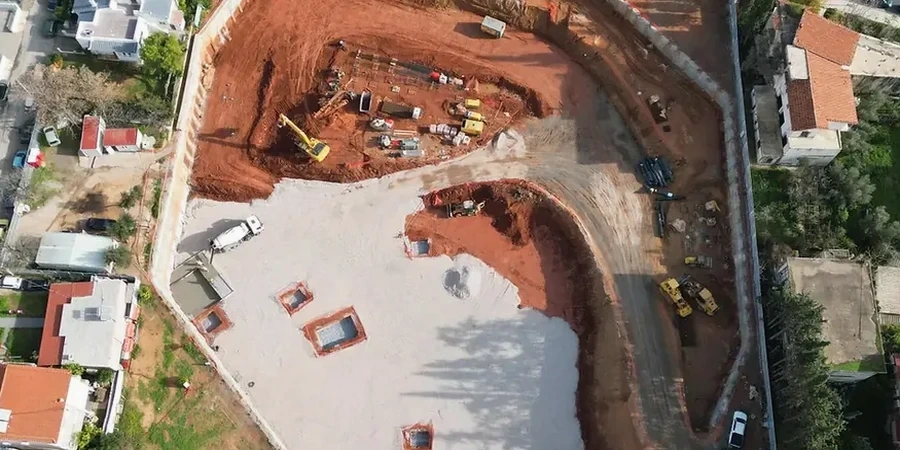
Critical ground factors in Rotorua
NZS 1170.5 and the Rotorua District Plan's Geothermal Hazard provisions define the risk framework, but real liability sits with hydrothermal alteration. A borehole log describing 'moderately altered ignimbrite' can mask a material that slakes to clay within hours of exposure to air. We require preservation of core samples in humidity-controlled containers and point load testing within 24 hours of recovery. The second critical hazard is geothermal fluid inflow: a single uncontrolled blowout at 90°C can scald workers, flood the excavation, and strip fines from the formation, creating a cavity that propagates to the surface. We design exclusion zones and specify redundant pumping with temperature-rated impellers. In the Whakarewarewa and Kuirau Park areas, where the geothermal reservoir is shallow and pressurised, we often recommend relocating the excavation footprint rather than attempting brute-force dewatering. The cost of ignoring these hazards is not just a construction delay; it is the permanent loss of ground strength and potential damage to the geothermal features that define Rotorua.
Our services
Deep excavation design in Rotorua bridges structural engineering, geothermal science, and hydrogeology. The two service packages below reflect the minimum scope for a site in the Taupō Volcanic Zone. Both are delivered by a team with direct experience on geothermal brownfield projects across the Bay of Plenty.
Thermal-Mechanical Excavation Support Design
Full NZS 3404-compliant design package including geothermal ground model, temperature-de-rated structural checks for shoring elements, instrumentation specification for tieback load cells rated to 85°C, and a construction staging plan that sequences dewatering with support installation to minimise thermal shock to the formation.
Geothermal Dewatering & Depressurisation Strategy
Design of pumped well systems with temperature-tolerant submersibles, fluid chemistry sampling protocol to identify scaling risk, and a 3D groundwater model that predicts drawdown radius to avoid affecting nearby geothermal surface features and shallow domestic bores.
Questions and answers
What is the typical cost range for geotechnical design of a deep excavation in Rotorua?
For a project in Rotorua's geothermal zone, a complete design package typically ranges from NZ$2,990 for a small single-basement investigation to NZ$14,400 for a multi-level excavation requiring a thermal-mechanical ground model, instrumentation specification, and staged construction planning. The final figure depends on depth, proximity to surface geothermal features, and whether the site sits within a mapped Geothermal Hazard Overlay.
How does Rotorua's geothermal activity affect excavation support design?
Elevated ground temperatures reduce the yield strength of steel reinforcement and accelerate shotcrete curing. Hydrothermal alteration can turn a strong ignimbrite into a weak clay with very little warning. We address this by logging the full thermal profile of every borehole, de-rating structural elements per NZS 3404, and preserving core samples for rapid strength testing before alteration progresses. Dewatering design also accounts for the risk of mineral scaling clogging pumps at high fluid temperatures.
Do you need a resource consent for a deep excavation near Rotorua's geothermal features?
Almost certainly yes. The Rotorua District Plan includes a Geothermal Hazard Overlay that triggers consent requirements for excavations deeper than 3 metres or any activity that could alter subsurface fluid pressures. We prepare the supporting geotechnical assessment, including a statement of effects on nearby surface features, and can coordinate with your planner to submit the package to the Bay of Plenty Regional Council.