In Rotorua, the ground itself often reminds you why standard foundation approaches fall short. The combination of shallow geothermal activity, hydrothermal alteration zones, and the region’s proximity to the Taupō Volcanic Zone creates a subsoil profile that shifts in stiffness over very short distances. A conventional fixed-base design amplifies these irregularities, transmitting every tremor directly into the structure. Base isolation, on the other hand, decouples the building from the ground motion. The team here works with data from local CPT campaigns and downhole velocity profiling to calibrate isolation systems that actually match the thermal and seismic conditions found beneath the city. For sites near the Sulphur Point shoreline or within the caldera rim margins, integrating findings from a targeted CPT test prior to isolator specification is a practical step that avoids overdesign while maintaining ductility targets under NZS 3404.
Decoupling a structure from Rotorua’s thermally active ground requires an isolation system whose material properties remain predictable when the substrate is hotter than the ambient air.
Technical details of the service in Rotorua
Critical ground factors in Rotorua
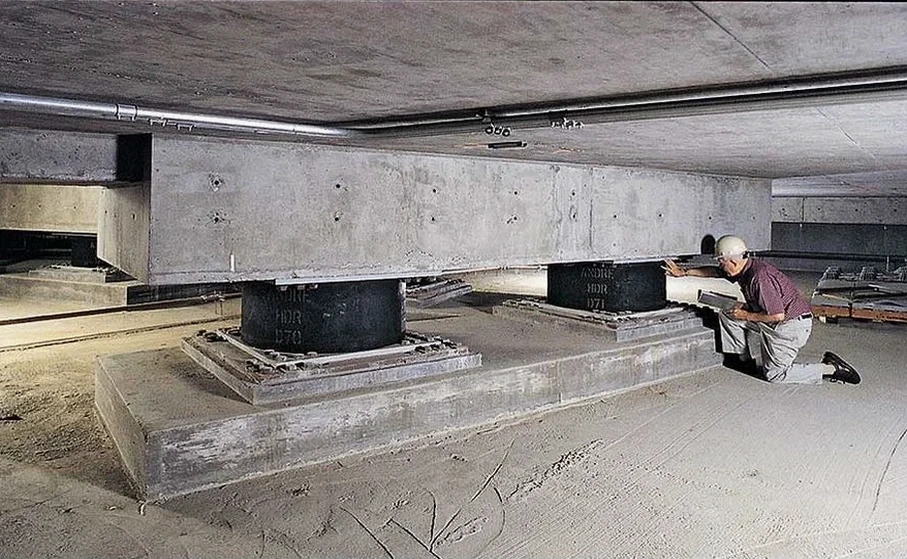
A five-storey mixed-use block near Fenton Street encountered a lens of kaolinite-rich altered tuff during excavation, with undrained shear strength dropping below 40 kPa at just 3.5 metres depth. The original fixed-base design would have required deep piled foundations through the compressible zone, with pile heads exposed to acidic condensate. By shifting to a base-isolated solution with a rigid diaphragm slab above the weak layer, the isolators were placed in dry, ventilated pits that allow periodic inspection. The moat walls were lined with HDPE to block sulphur-laden groundwater ingress. Overlooking the geothermal factor in Rotorua is the quickest way to turn a seismic-resilient concept into a maintenance liability: elastomer stiffening, lead core corrosion, and bolt embrittlement all accelerate when the thermal environment is ignored. The NZGS guidelines explicitly require durability assessment for foundations in hydrothermal areas, and the isolation system falls squarely within that scope.
Our services
The base isolation engineering workflow in Rotorua integrates site characterisation, device specification, and peer review stages aligned with the local regulatory pathway. Every scope is tailored to the geothermal and seismic hazard map data published by GNS Science.
Site-Specific Seismic Hazard and Isolator Selection
Development of the design response spectrum from probabilistic seismic hazard assessment, selection of lead-rubber or high-damping rubber isolator properties, and nonlinear time-history verification using ground motions compatible with the Taupō Volcanic Zone source model.
Geothermal Durability and Superstructure Interface Design
Specification of isolator compounds rated for continuous exposure to 60–80°C, corrosion protection for steel components in acidic groundwater, and detailing of the isolation plane, moat walls, and flexible utility connections per NZS 3404.
Peer Review and Construction-Phase Monitoring
Independent technical review to satisfy council consenting requirements under the Building Act, plus periodic prototype testing witness, isolator installation verification, and long-term monitoring system design for post-occupancy performance tracking.
Questions and answers
How much does base isolation seismic design cost for a commercial project in Rotorua?
For a medium-scale commercial building in Rotorua, the full engineering package — covering seismic hazard analysis, isolator specification, structural interface design, and peer review documentation — typically falls between NZ$5,980 and NZ$12,810. The final figure depends on the number of isolators, the complexity of the geothermal durability provisions, and whether nonlinear time-history analysis is required by the consenting authority.
Which New Zealand standards govern base isolation design?
NZS 3404 governs the steel connection design at the isolator interface, while NZS 4203 and NZS 1170.5 define the seismic actions and loading combinations. The NZGS foundation design modules provide specific guidance for construction on volcanic and geothermal terrain. International references such as ASCE 7 are often used as comparative benchmarks during peer review.
How does Rotorua’s geothermal ground affect isolation bearings?
Elevated ground temperatures accelerate elastomer stiffening and can promote corrosion in lead cores and steel reinforcing plates. The design must specify high-temperature compound formulations and, in aggressive groundwater conditions, include impermeable liners or ventilated isolator pits to prevent direct contact with acidic hydrothermal fluids.
Does base isolation eliminate the need for deep foundations in poor ground?
Not necessarily, but it can simplify the foundation solution. On compressible hydrothermal clays, a rigid base slab above the weak layer with isolators placed on shallow pads often avoids the cost and thermal degradation risk of deep piling. Site-specific geotechnical investigation determines whether this approach is viable.